Understanding Sexual Violence




Sexual violence can be confusing, overwhelming, and hard to name.
If you are trying to understand what happened to you or someone you love, this page is a place to start.
Whether the harm was recent or years ago, survivors deserve to be listened to, believed, and supported.
If you have been sexually assaulted or abused, SAVA Center is here to help.

Understanding sexual violence terms
Sexual violence is an umbrella term used to describe anything that negatively affects someone physically or emotionally using sexual acts, language, or targeting their sexuality. Sexual violence can include sexual harassment, sexual assault, or child sexual abuse.
Sexual harassment is any unwelcome behavior of a sexual nature that happens repeatedly at school or work.
Sexual assault is defined as any unwanted, forced, or coerced sexual activity without the consent or against the will of another person.
Child sexual abuse is any act that is sexual in nature involving a child, where a child is unable to give consent and there is an imbalance of power. This means the abuser (an adult or another peer) has power over the child.
Facts about sexual violence:
1 in 2 women and 1 in 3 men have experienced sexual assault during their lifetime (Basile et al., 2022).
In Colorado, the majority of sexual assaults involve victims ages 17 or younger, with youth ages 14-17 experiencing the highest rates across all age groups (BJS, 2021).
Women who are sexually assaulted before their 18th birthday are twice as likely to be sexually assaulted again (Black et al, 2011).
Individuals with disabilities experience sexual assault at a rate seven times higher than individuals without disabilities (Shapiro, 2018).
There is no such thing as a “normal” reaction.
Every survivor has a reaction to sexual violence victimization that is unique to them. These reactions are often influenced by past experiences, including past trauma. There isn’t one way to respond to sexual assault or abuse. It is normal to experience grief, denial, blame, shame, anger, humiliation, etc. after being sexually assaulted or abused.
Victims of sexual assault are at a greater risk for experiencing mental health conditions including anxiety, depression, suicidal thoughts, post-traumatic stress disorder (PTSD), substance abuse, memory problems, and more (Dworkin, 2020).

Frequently Asked Questions
Whether you were sexually assaulted hours, days, weeks, months, or years ago, SAVA is here to help.
Listed below are frequently asked questions survivors and their loved ones may have in the aftermath.
-
SAVA Center is here to help you. Consider calling our 24-hour crisis hotline to speak with an advocate. SAVA Advocates are specially trained to listen, believe, and support. When you call the crisis hotline, an advocate will walk you through your reporting options and connect you with SAVA advocacy and therapy services.
Here are a few things you may consider:
Whether or not you want to seek medical attention
Whether or not you want to report to law enforcement
You are not required to report or seek medical attention immediately. However, if you choose to report at some point, obtaining a forensic exam within the first 7 days is optimal.
-
Adult victims of sexual assault and adult survivors of child sexual abuse are not required to report. In fact, approximately 77% of sexual assaults go unreported, which means over 3 out of 4 sexual assaults are never reported to the police (Thompson & Tapp, 2022).
Minor victims may be required to report. If a minor discloses to a mandated reporter (a teacher, counselor, etc.), the mandated reporter is required by state law to report to the proper authorities.
-
Adult victims of sexual assault in Colorado have three reporting options. They are:
Report the sexual assault to police;
Report the sexual assault to medical providers without a police investigation (referred to as medical reporting); or
Report to medical providers but remain anonymous to the police (referred to as anonymous reporting).
In all sexual assault cases, victims determine whether to have a medical forensic exam.
Victims are not financially responsible for the cost of the evidence collection portion of the exam. During the exam, the individual determines what, if any, evidence will be collected.
-
A medical forensic exam is a specialized medical visit after a sexual assault. In a forensic exam, victims are physically evaluated, treated for injuries, and can be tested for the risk of pregnancy or sexually transmitted infections. During a forensic exam, evidence is collected and documented for investigative purposes. This includes physical findings from victims’ bodies and clothing. Forensic exams are typically conducted within 7 days of the sexual assault.
You are not alone. You can request a SAVA advocate to accompany you to the hospital to get a medical forensic exam.
-
In Larimer and Weld Counties, forensic exams are offered at the following locations:
Fort Collins:
Fort Collins Medical Center (FCMC) - Banner Health
UCHealth Poudre Valley Hospital
UCHealth Harmony Campus
Greeley
North Colorado Medical Center - Banner Health
UCHealth Greeley Hospital
UCHealth Greeley Emergency and Surgery Center
Loveland
UCHealth Medical Center of the Rockies
-
Regardless of when the victimization occurred, SAVA Center is here to help. SAVA Advocacy and Therapy services are available to you, no matter when you were sexually assaulted or abused.
Statute of Limitations laws vary, and a SAVA advocate can walk you through your options. Consider calling SAVA’s 24-hour crisis hotline to talk about your specific questions.
-
Reporting an assault to police may seem like an obvious reaction to being violated. However, most victims don’t report to law enforcement, and many never tell anyone at all. Research shows that approximately 77% of sexual assaults go unreported, which means over 3 out of 4 sexual assaults are never reported to the police (Thompson & Tapp, 2022).
Reasons may include: fear of the criminal justice system, fear of not being believed, fear of retaliation, shame, self-blame, fear of getting in trouble, and more.
Myth vs. Fact
MYTH
Victims ask to be sexually assaulted.
The victim is never to blame. The only person to blame is the person who committed the sexual assault.
FACT
MYTH
“Roofies” like GHB and Rohypnol are the most common date rape drugs.
Alcohol is the number one drug used facilitate sexual assault (Anderson et al., 2017). At least half of all sexual assaults involve alcohol (Teravskis et al., 2022).
FACT
MYTH
Husbands cannot rape their wives.
Anyone has a right to say no to their partner. Sex is never “owed” to someone, regardless of their relationship status.
FACT
MYTH
False reporting is common.
Research estimates that just 2-8% of sexual assault reports are false (Lonsway et al., 2023).
FACT
MYTH
Sexual assault occurs only among strangers.
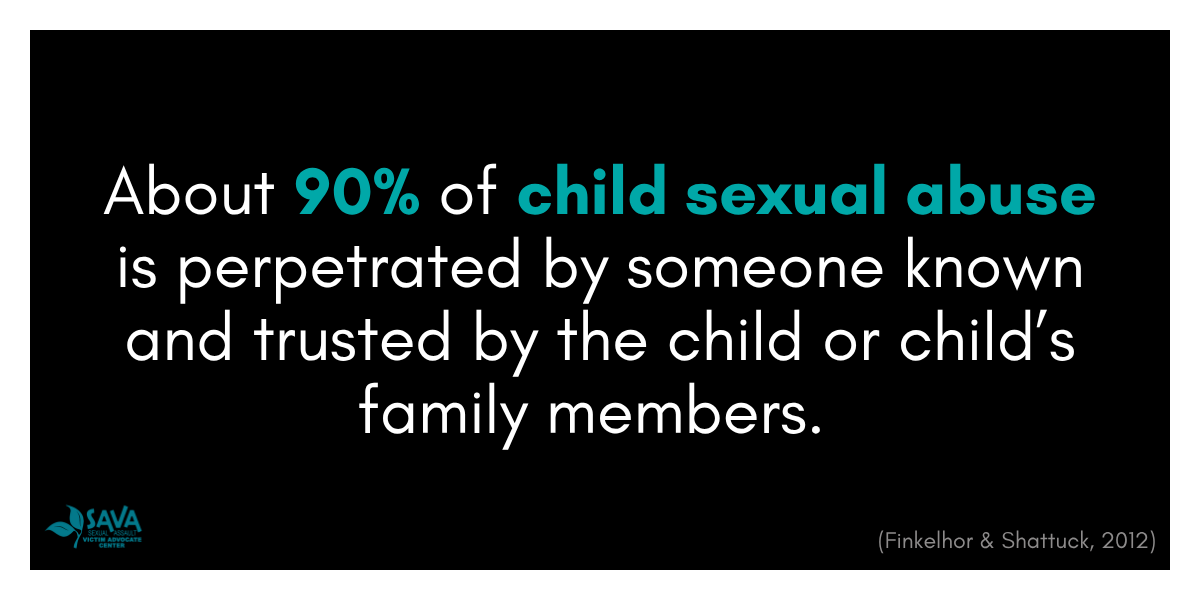
80% of sexual assaults are committed by someone known to the victim (Morgan & Truman, 2018). Additionally, about 90% of child sexual abuse is perpetrated by someone known and trusted by the child or child’s family members (Finkelhor & Shattuck, 2012).
FACT
Need to talk? SAVA is here.
Need to talk? SAVA is here.
To get connected with an advocate, call our 24/7 crisis hotline at (970) 472-4200 or contact us through email.
Please note, email is not monitored 24/7.